

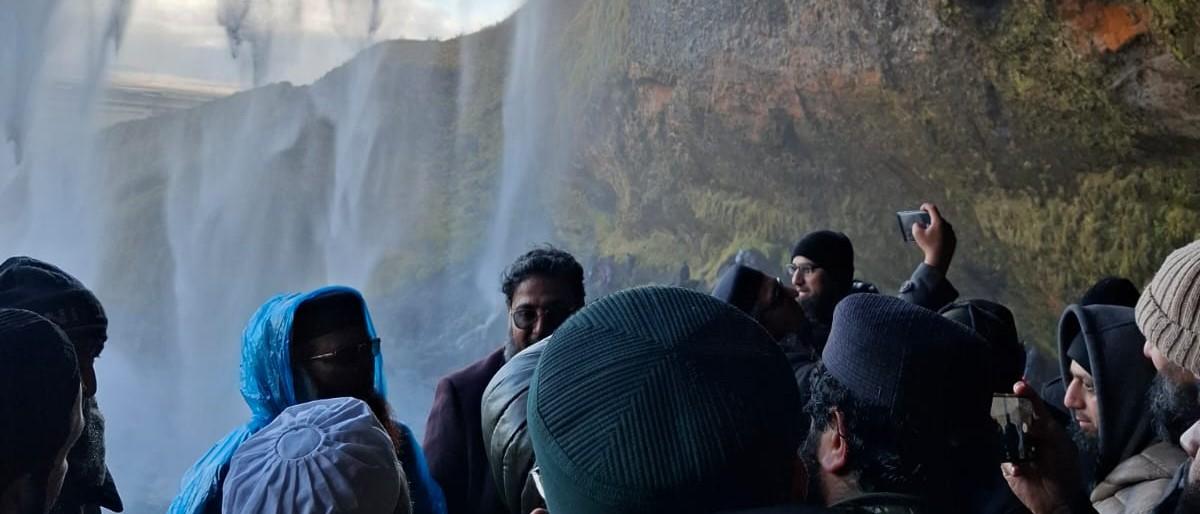
Skógafoss, Iceland | Tuesday, 20 October 2026
During our memorable journey to Iceland in the company of Shaykh al-Islam Mufti Muhammad Taqi Usmani Sahib حفظه الله, we visited some of the country's most spectacular natural attractions.
On Tuesday 20 October, we travelled along Iceland's southern coast, visiting two magnificent waterfalls: Seljalandsfoss and Skógafoss.
At Seljalandsfoss, we had the remarkable experience of walking behind the waterfall. The path was rocky, wet and slippery, and considerable care was needed to navigate it safely.
Despite the challenging conditions, Hazrat, wearing a blue waterproof cape and supported by companions, completed the walk behind the waterfall.
Later that afternoon, we arrived at Skógafoss, another breathtaking waterfall, where the water cascades powerfully down the cliffs.
It was against this beautiful natural backdrop that Hazrat recited a couplet which would become one of the most memorable spiritual lessons of our journey.
A Beautiful Couplet with a Profound Message
Hazrat recited:
انہی پتھروں پہ چل کر اگر آ سکو تو آؤ
میرے گھر کے راستے میں کوئی کہکشاں نہیں ہے
If you can walk upon these very stones, then come.
There is no glittering galaxy along the path to my home.
At first, these may appear to be simple poetic words describing a difficult journey.
But the following morning, during our breakfast Majlis at Hotel Óðinsvé in Reykjavík, Hazrat returned to this couplet and explained its deeper meaning.
He clarified that the lines were written by a poet, but he was applying their message to the journey of Deen.
The word Kehkashan (کہکشاں) refers to a galaxy, something bright, beautiful and glittering.
The poet is effectively saying: if you wish to reach me, you must be prepared to walk across difficult, uneven stones. Do not expect the path to be decorated with beauty and comfort.
Hazrat explained that the same principle applies to our journey towards Allah Ta'ala.
The Path of Deen Requires Sacrifice
We all desire the pleasure of Allah, closeness to Him and success in the Hereafter.
However, we sometimes expect this journey to be easy.
We want the rewards of obedience without experiencing inconvenience. We desire spiritual progress without necessarily changing our habits. We hope for Jannah while remaining reluctant to make sacrifices.
Yet following Deen inevitably requires effort, discipline and perseverance.
There will be occasions when fulfilling our religious obligations means overcoming tiredness, resisting temptation, changing established habits or making choices that are not always popular.
The path may contain stones.
But the presence of stones does not mean we are travelling in the wrong direction.
Sometimes, those very difficulties are part of the journey towards our destination.
Are We Following Deen, or Changing Deen to Follow Our Desires?
This particular advice also made me reflect on something we are increasingly witnessing in contemporary discussions about Islam.
Rather than making the effort to bring our lives into accordance with Deen, there can be a temptation to reinterpret or reshape Deen so that it accommodates our existing desires, lifestyles and personal comforts.
Instead of asking, "What does Allah require of me, and how can I strive to fulfil it?" the question can become, "How can religion be made to fit the way I already want to live?"
There is an important distinction here.
Islam has a rich tradition of legitimate scholarly differences. Within the four recognised Sunni schools of jurisprudence - Hanafi, Maliki, Shafi'i and Hanbali - there are differences of opinion on many matters of religious practice.
These differences are grounded in scholarly methodology, evidence and centuries of careful legal reasoning. They are not simply attempts to make religion convenient.
And while the schools may differ on particular rulings, none presents Deen as a path that requires no discipline, restraint or sacrifice.
Every school recognises obligations that must be fulfilled, prohibitions that must be avoided and desires that must sometimes be resisted.
Legitimate scholarly flexibility is one thing. Changing religious principles merely because they conflict with our preferences is quite another.
The Deen is not something we continually reshape to suit our desires. Rather, our desires and conduct must be disciplined and guided by Deen.
The Deen Is Easy - But Not Everything Easy Is Deen
This also reminds me of a profound observation made by a good friend of mine, who himself is a student of Hazrat Mufti Muhammad Taqi Usmani Sahib.
Once, whilst we were discussing a mas'ala and I was suggesting some dispensations, he reminded me that Rasulullah ﷺ said:
إِنَّ الدِّينَ يُسْرٌ
"Indeed, the religion is easy."
(Sahih al-Bukhari, Hadith 39)
He explained that Rasulullah ﷺ said: Ad-Deenu Yusrun (الدِّينُ يُسْرٌ) - The religion is easy.
But he did not say: Al-Yusru Deenun (الْيُسْرُ دِينٌ) - Ease itself is religion.
I remember thinking how profound this simple distinction was.
Islam is indeed a religion of ease. Allah has provided concessions, allowances and legitimate flexibility within the Shari'ah. These are part of the mercy and wisdom of Deen.
However, this does not mean that we can make personal convenience the ultimate criterion for determining what is right and wrong.
The ease must be found within the framework of Deen, rather than Deen being reshaped around whatever we find easy.
Sometimes obedience will be comfortable. At other times, it will require sacrifice.
And that brings us back to the stones in Hazrat's couplet.
Jannah Is Surrounded by Difficulties
Hazrat's advice also reminded me of a profound Hadith of Rasulullah ﷺ:
حُجِبَتِ النَّارُ بِالشَّهَوَاتِ، وَحُجِبَتِ الْجَنَّةُ بِالْمَكَارِهِ
The Fire is veiled by desires, and Paradise is veiled by difficulties.
(Sahih al-Bukhari, Hadith 6487; also narrated in Sahih Muslim, Hadith 2822, with the wording حُفَّتِ)
This Hadith captures the very essence of the lesson.
The path towards Jahannam can appear attractive because it is surrounded by Shahawat - desires, temptations and pleasures that appeal to the Nafs.
The path towards Jannah, on the other hand, is surrounded by Makarih - matters that a person may naturally find difficult or uncomfortable.
Waking for Fajr when we would rather sleep, controlling our anger when we want to retaliate, lowering our gaze, resisting unlawful temptations, fulfilling our responsibilities and remaining truthful when dishonesty might bring an advantage: all of these require effort.
Yet these are among the sacrifices through which a believer seeks the pleasure of Allah.
The Hadith does not mean that Deen is devoid of happiness or that a believer must constantly experience hardship. Rather, it reminds us that what is immediately pleasurable is not necessarily beneficial, and what requires effort is not necessarily harmful.
The ultimate destination must remain more important than the temporary attractions or difficulties encountered along the way.
Allah Promises Guidance to Those Who Strive
Allah Ta'ala says:
وَالَّذِينَ جَاهَدُوا فِينَا لَنَهْدِيَنَّهُمْ سُبُلَنَا وَإِنَّ اللَّهَ لَمَعَ الْمُحْسِنِينَ
Those who strive for Our sake, We shall surely guide them to Our ways. And indeed, Allah is with those who do good.
(Surah al-'Ankabut, 29:69)
This verse reminds us that guidance is connected with sincere effort.
We are not expected to achieve perfection overnight. Rather, we are encouraged to make a genuine effort to obey Allah, resist wrongdoing and remain steadfast when challenges arise.
In his public Bayan at the Grand Mosque of Iceland the following evening, Hazrat similarly reminded the congregation that practising Deen requires discipline.
He gave the familiar example of someone who gets out of bed to go to work despite feeling tired.
If we can overcome our reluctance for worldly responsibilities, should we not also make an effort for our responsibilities towards Allah?
A Lesson I Took Away
We had spent the afternoon navigating wet, slippery and uneven paths around Iceland's magnificent waterfalls.
The beauty of the destination was undeniable, but reaching some of the most remarkable viewpoints required effort.
And that is when Hazrat first recited the couplet, in this amazing setting.
The following morning, Hazrat transformed that physical experience into a spiritual lesson.
It made me reflect on how easily we become discouraged when practising Deen requires us to change our routines, resist our desires or make sacrifices.
It also reminded me of the danger of trying to remove every difficulty from religious life by adjusting the religion itself, rather than making the effort to adjust ourselves.
The real question is not whether the path contains difficulties.
The real question is whether we are prepared to continue walking when it does.
The stones along the path should not make us forget the beauty of the destination.
And perhaps that is the enduring message of the couplet:
انہی پتھروں پہ چل کر اگر آ سکو تو آؤ
If you can walk upon these very stones, then come.
May Allah Ta'ala grant us sincerity, perseverance and steadfastness upon His Deen, protect us from becoming slaves to our desires, and enable us to continue striving towards His pleasure, whatever challenges we encounter along the way.
Ameen.
This reflection is based on Hazrat Mufti Muhammad Taqi Usmani Sahib's recitation of the couplet during our visit to Skógafoss waterfall on 20 October 2026, and his explanation during the breakfast Majlis on 21 October. The Hadith references, Hazrat's students' observation and the personal applications are my own reflections inspired by Hazrat's advice.
This is Part 2 of the series In the Company of Mufti Taqi Usmani. Read Part 1: Fame and Humility: Is Public Recognition Always a Blessing?
WhatsApp updates
Be notified when something new is published
Join our WhatsApp broadcast list for a short message whenever a new article, Q&A answer or lecture goes live. Updates only - no group chat, and your number is never shared.
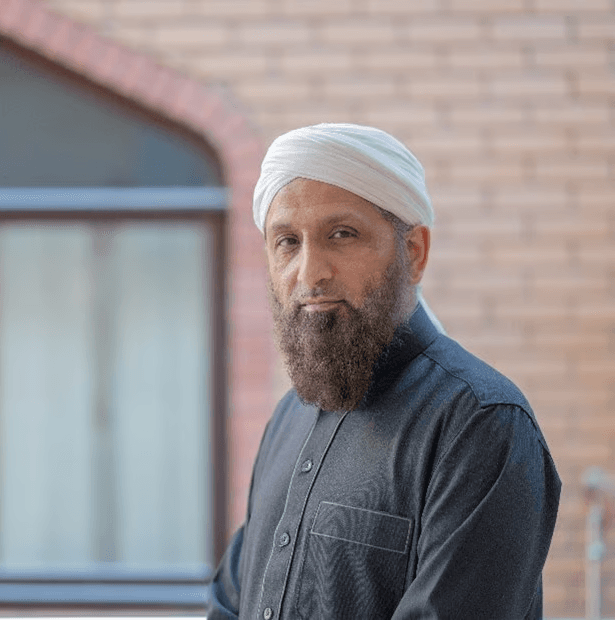
Shaykh Yunus Dudhwala
NHS hospital chaplain of 28 years, Islamic scholar, speaker and writer.
More about Shaykh Yunus →