Embracing Death with Dignity, Care, and Faith
Compassion, Dignity and Respect at End of Life
5/4/20263 min read
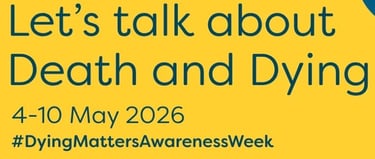
From 4–10 May, Dying Matters Awareness Week invites us to confront one of the most universal yet often avoided realities of human existence: death. This year’s theme, “Let’s talk about Death and Dying,” is both timely and necessary. In a society that frequently distances itself from الموت (death), the call is not merely to talk, but to reflect, to understand, and perhaps most importantly, to reframe how we approach the end of life.
Over the past few weeks, I have found myself reflecting deeply on this theme through two very different, yet equally profound experiences.
The first was participation in a panel discussion at King’s College London, where the topic of Assisted Dying was debated. The language surrounding Assisted Dying is often framed in terms of dignity, autonomy, and choice. It is presented as a compassionate response to suffering, a means of giving individuals control over how and when they die.
Yet, I could not help but feel that this framing risks overlooking something essential: the profound dignity that can be found not in hastening death, but in accompanying it.
The second experience brought this reality into sharp and deeply personal focus. A close aunt of mine spent her final days at home, unconscious and receiving palliative care. For over a week, her family gathered around her, children, grandchildren, and extended relatives, taking turns to sit by her side. She was never left alone. There was a quiet rhythm of care: carers visiting daily to clean and attend to her needs, family members reciting prayers, and an atmosphere filled not with despair, but with حضور (presence), محبت (love), and وقار (dignity).
What I witnessed was not a loss of dignity, but its fullest expression.
In those moments, dignity was not about independence or control. It was about being held in a web of relationships, about being honoured until the very end, about being seen, not as a burden, but as a beloved soul transitioning from this world.
There were difficult conversations too. Decisions around nutrition and hydration were particularly challenging for the family. The instinct to nourish and sustain life is deeply ingrained, and withholding these can feel counterintuitive, even distressing. Yet, with guidance from healthcare professionals, it became clear that at this stage, such interventions could cause more harm than benefit. Gradually, the family came to accept this as part of the natural dying process.
This acceptance did not come easily, but it came with understanding, and ultimately, with peace.
These two experiences highlight a crucial tension in contemporary discussions about death. On one hand, there is a growing movement advocating for Assisted Dying as a means of preserving dignity. On the other, there is the often under-recognised power of palliative care, of providing holistic, compassionate support that addresses not only physical symptoms, but emotional, social, and spiritual needs.
The question we must ask is this: have we truly invested enough in making good deaths possible?
A dignified death should not be something that requires ending life prematurely. It should be something we are able to offer through proper care, presence, and compassion. This means adequately funding palliative care services, supporting families, training healthcare professionals, and creating spaces where death is not hidden away, but gently accompanied.
From a faith perspective, death is not an end, but a transition. It is a return to our Creator, a لقاء (meeting) with Allah. The Prophet ﷺ taught us not to wish for death out of hardship, but to live with purpose and to meet death with readiness. In this light, the final moments of life carry immense spiritual significance. They are an opportunity for reflection, repentance, and remembrance.
To embrace death, therefore, is not to seek it prematurely, but to accept it when it arrives, naturally, and with dignity.
Dying Matters Awareness Week is an invitation to have these conversations openly: within our families, our communities, and our institutions. We need to talk about what matters at the end of life. We need to prepare, not only practically, but spiritually. And we need to ensure that no one faces death alone, unsupported, or without dignity.
My aunt’s passing was a reminder that even in unconsciousness, a person can be surrounded by love. That even in decline, there can be honour. And that even in death, there can be beauty.
Perhaps the real dignity in dying lies not in controlling death, but in how we care for ourselves, and for one another until the very end.